Showing posts with label buy a homestead. Show all posts

Friday, 6 July 2018

You Can Afford Your Homestead Dream… But You May Not Recognize it at First.

Do you dream of one day owning a homestead of your own, a place where you can raise animals and gardens to provide good, wholesome food for your family? No more city councils deciding if you can raise chickens or not. No more neighbors complaining about some animal or other of yours. The dream of owning your homestead need not remain a dream; it can become your reality.
There is a difference between owning a homestead and living a homestead life. People can buy a farm but that does not make them farmers. Your dream homestead also may not look anything like your dream when you first find it. I believe that being a homesteader means living the experience of creating that homestead. You get to design, build, fix, move, and adjust the homestead so that it works best for you. In doing so, you will become a part of that homestead and not just a property owner. The fulfillment of homesteading will come in the testimonies you give about overcoming the obstacles you faced and the home and life you created.
You can take all the great ideas you have been reading and talking about and put them to use on your very own homestead, once you finally have it. You don’t need to wait for some magical day to appear, or the perfect opportunity to fall into your lap. You can place yourself upon the path of homesteading opportunity now. You may have changed your perspective, shed some biases and possibly have the vision to see that diamond in the rough.
During the current economic downturn, affordable housing has not necessarily remained affordable for many. Job losses numbering in the hundreds of thousands each month give us cause to wonder if we can hold onto what we now have, much less wait long enough for that magical homestead. In harder times it is not uncommon to feel a greater desire for self-sufficiency as well as increased fear of the unknown. I believe that there is no better time to find that affordable homestead than the present.
Banks and lenders are fearful of foreclosing on high-risk loans already made. Property values in many areas continue to fall. Homeowners are unable to sell homes and new buyers are unable to get the loans they need. Thus the foreclosure cycle spins faster and faster.
By turning these negatives into advantages you can own your homestead now. Many rural areas that would suit a homestead well are littered with abandoned, run down or unkept mobile homes with land that would work perfectly well as a homestead for someone who can see the diamond in the rough.
I realize that a rundown “trailer” is not the object of your desire. Look past that mobile home and look at the land. What do you see? Is there room for the pasture you need? Is there room for gardens, crops, animals, a barn, a pond etc? As you gaze through the three-foot tall grass growing in and around the appliances that always seem to be left in the front yard, run through the list of characteristics you have dreamed your land would include. Chances are if you look for them, this forgotten and abused land has the potential for you to create them. Forget about the trailer for a moment and just picture your homestead sculpted into this land.
Now open your eyes and look at the ugly mobile home again. Chances are it is an old single-wide that looks terrible but looks can be deceiving. That old home probably has all the infrastructure in place that you need to start your homestead but previously could not afford to install yourself. That home probably has its own well, septic and electric already set up. You don’t have to keep the mobile home on that land. You can either have it moved or demolished (some areas do not allow old mobile homes to be moved). Once that home is gone, you can build or install the type of housing you prefer. If your newer home is more modern it might need an upgrade to the electric service but maybe not. So many articles and books are written today teaching how to use less power or how to create power that an upgrade may be totally unnecessary. Even if you go so far as to live totally off the grid, the available power during the construction of your homestead can make things much easier. Remember, you are carving your dream out of this clay and it will take work.
By discovering the potential for your homestead among the overgrown, forgotten land under that mobile home you have begun to polish that diamond. You are beginning to see the potential value but the owners and sellers of these properties only see an old, abandoned “trailer” on some forsaken land. This is your negotiating position of strength. Many of these properties have been foreclosed by banks and are now problem, non-performing assets known as Real Estate Owned (R.E.O’s) that the banks want, and need, to get off of their books. Potential sellers may own the property free and clear of any debt but have no idea on how to sell the property. They can’t find buyers with banks that are willing to finance this type of property. These owners will often consider about any suggestion to get rid of the property so that they can be free of paying the taxes.
If the property is free and clear of loans and liens then this seller may very well consider owner-financing the sale. They might consider a rent-to-own proposal or contract for deed. In many cases this type of arrangement might not require much, if any, cash up front since you are taking a property in such disrepair. Just be sure to set the purchase price and terms based upon the condition of the property as it now stands and not after you have done all the work improving it.
If you are buying the property from a bank that has completed the foreclosure then you will likely be making a bid or offer through a real estate agent. Not all agents like these types of properties so keep asking around until you find a good buyer’s agent (not the standard seller’s agent). You won’t be offering much and that means very little in sales commission for the agent but I have found that a good agent can learn a great deal from how we buy the property and what we do with it. This may even open up a new market niche for the agent. Don’t let any agent talk you into offering more money. Remember that this property is a bad asset as far as the bank is concerned. They don’t have any emotional attachment to the property and most likely have never even seen a picture of it. You need not be afraid of insulting a bank or your agent with a low offer.
It has been my experience that in many cases you can buy this property for less than the cost of installing the well, septic systems and electrical service. This means that if your offer is accepted, you will be receiving the land and home for free!
Offer as low as you like and see how the bank reacts. If they take your first offer, great, but I can tell you from experience, you will be kicking yourself for not having offered even less. If they counter your offer then up your offer a bit more but not too much. Stay within your budget. If you hardly have any budget at all then you won’t be overpaying! Keep your goals in mind and make that offer low. You can always walk away. You don’t have to buy but the banks and these types of owners need to sell.
Your offer should be contingent upon your inspection of the home and property no matter who is selling the property. Never take a seller’s word about a property. Do your own homework and bring along people you trust who know more than you to help you make certain this property can become the homestead you desire.
This due diligence homework cannot be stressed enough. You want to have a title search conducted and have a professional title agent or closing attorney conduct the closing. Title insurance is typically based upon the purchase price and since you won’t be paying very much for the property the one time insurance fee won’t cost you much either. Just make sure you have a title search conducted and the title insured.
Go to the local county website and in many cases you can look up this property using their Geographic Information System which will allow you to view the property lines from a bird’s eye view. You can get a general idea of the property lines (but even the G.I.S. will remind you that these are not to be used in lieu of a survey), print this map and walk the property yourself. This will also aid you in deciding where best to place your plans for you homestead. You might, for instance, find that the barn would be better someplace else, or that a stream runs through part of the property but was so overgrown you missed it originally.
This will also give you an idea on the type of housing you can place on this property. You will want to check and see what is allowed not only by the zoning but also by the private deed covenants and restrictions. From there you can decide upon the housing that bests suits you and the property. Maybe it’s a log cabin, stick-built home, yurt, shack, tent or even that mobile home (fixed up) or a newer model.
Why not recycle your housing like you try and do everything else? In most aspects of simple living, homesteading and self-sufficiency, we seek to recycle the old to provide a new use. I would recommend that you consider repairing that used mobile home or at least consider replacing it with a more modern, used or repossessed mobile home.
Back in the 1990’s I discovered that owners of mobile homes were often abandoning homes in parks. Much like the stick-built owners of today, these mobile-home owners could not find buyers with bank financing to purchase their homes. This meant that they either had to walk away from their homes or sell for whatever cash people did have. I was able to buy 3 bedroom, 2 bath, 14 feet by 70 feet, singlewide mobile homes for $500 to no more than $3,000 cash. In many cases I was given the homes for free so that seller could move and not be responsible for paying lot rent to the park. These homes did need work but if you are buying a three bedroom, two-bath home for $500 you have a lot of room in the budget for repairs. I found out that there were people all over this country making a business out of buying these cheap singlewides in parks. My area was not some unique, cheap mobile home utopia.
Mobile homes are considered personal property unless some legal work is done to “attach” the home to the real estate. Typically this involves “retiring the title” of the mobile home. In most states, mobile homes are bought and sold using titles exactly like the one used to buy and sell cars. The registration was done at the Division of Motor Vehicles (or whatever similarly named agency your state has) just like the purchase of a car. Liens on mobile homes appear on the title just as they do on car titles. Some states vary a bit or only require titles for later model homes but the concept is the same as buying and borrowing against a car.
The cheapest alternative will, most likely, be to simply repair the mobile home that is already on the land. I have found you can repair and rehab most any old mobile home into a dollhouse. I believe these homes are much easier and far less expensive to work on than a stick-built home and since you are doing the work it can be done to standards that suit you. Trust me, if I can learn to fix these homes, anyone can.
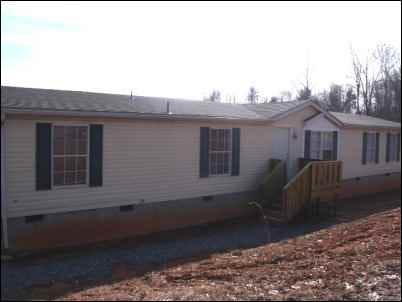
If you choose not to repair the old trailer that is currently on the land, you might consider buying a used or repossessed mobile home a moving it to this land. Moving a mobile home is not necessarily cheap and will vary greatly by location. I live in the mountains of North Carolina with narrow, winding roads, which makes moving mobile homes a bit frightening, even to watch. The cost to move a singlewide runs about $1,500 with the mover leveling the home, setting up the home on blocks (to satisfy our local code) and strapping it with tie downs. Moving doublewides tends to cost a little more than twice the cost of a moving a singlewide because the movers have to not only move two sections of the home but also break apart the halves and put them back together again.
Once you move the home to your land you now have a home complete with doors, windows, furnace, plumbing and electrical. You may want to install skirting or a block foundation along with a deck or steps to complete the home. If you choose to remain off the grid then you are pretty much done with the home and are now ready to make your own modifications for solar, wind or whatever alternative power you may choose.
In most states that I am aware of you will find that the mobile home can remain “personal property” for tax purposes, which can dramatically lower your annual tax bill, making this option even more affordable in the long run. So not only are we purchasing a nice-sized home for less than we might pay for a used car, we are paying taxes on it as if it were a used car. Every expense and tax we save money on further frees us from our financial handcuffs.
For those of us who can’t wait to begin homesteading, the shedding of the “trailer” bias or the removal of a mobile home from the land may be the catalyst to making our homesteading dreams a reality sooner rather than later. Even if you choose not to live in a mobile home on that land permanently, it may offer you the starter house or at the very least, truly affordable land and infrastructure that will become the diamond homestead of your dreams. By doing the work yourself instead of waiting a lifetime to buy someone else’s creation, you will have the testimony of experience to carry you through the obstacles and allow you to share these skills to help others create their homesteads. Now you will be able to invite them out to your homestead and show them just how you did it.

Thursday, 3 May 2018

Cheap Homestead land For Sale


Placing resources into the land is one of the methods to increase your cash, thus far for that to occur, you require locating the best diffident area existing to be purchased. The area is not a venture that depreciates, so putting resources into some would not abandon you disenchanted. Be that as it might, there's something else completely to it than just getting the main cheap area available to be bought by propriety or you find. There are scarce things that you have to see to instigate with before you select that said real land tract is acceptable irrespective of the cash. 

If you are opening a small farmhouse or homestead, probabilities are that you're seeking to purchase land and/or a farm that previously occurs. Many people pick to purchase fresh land and build their own farm on it, specifically those whose aims are homesteading versus opening a small farm business.

If you are searching for an off-grid site, survival land or a self-reliable property, you’re just a few clicks away from ruling the impeccable list. We propose an exclusive and wide-ranging variety of marketing and advertising programs, precisely directing country home buyers.  Even there is a lot of information about the Homesteads for sale on our site and a one-of-a-kind consumer’s nationwide record of country home buyers.  Also provide both, old-style and auction land marketing. Our proficiency and expertise in supportable real land joined with the marketing and presenting information results in a supreme winning blend.  If you are a purchaser or a vendor, our homestead blogs will guide you throughout the whole process and factors to consider buying the homestead.

How Much Land?
Determining how much space of land you are seeking for -- and how much you can afford -- is one of the main things to reflect. For either goal -- homesteading or limited farming -- you could go as little as an acre or two, or as large as many hundreds of acres. Here, you will require going back to your goals to point out what quantity of land will let you to reach those goals. 

Storm, water (micro-hydroelectric) and solar are all probable other energy systems you may need to apply on your tiny farm or homestead. What kinds of land will upkeep the kind of alternate energy most suitable to your climate? Will you be capable to utilize any of these methods to produce energy with the land you're considering? If you live in the city or the outskirts, the outlying countries that mount the city are a decent place to look into as distant as agricultural land for sale is concerned. While you are location hunting, you have to crosscheck whether there is sufficient water obtainable in the specific area.

Before searching for homestead land for sale, you must choose on which portion of the country you would like your farm to exist. this will totally depend upon what type of harvest you would like to crop; for example, whether you would need a dairy farm, a stud or plain animate farming. Also, some factors have to be considered

Suitable for Any Lifestyle
Select that land that can ensure utmost ease and offer the best of soft country style living that you and your family will actually love. 

A Step Nearer to the Inordinate Outside
What is great about your homestead are the close nature and environment. Growing trees, fresh air, and stunning landscapes will receive you the moment that you are looking for the homestead.  By means of getting the homestead land for sale, you will get closer to nature while spending time with your family.

A positive approach and a will to learn will get you through the hard times of maintainable living. Though living off the land is no gag but it’s up with the sun and occupied for hours. It’s random. An agrarian way of life is an enthusiastic plan to the rules of the countryside and to the maker. This will give you the best results. So, don’t always give up on your ideas of alive off the land.

Monday, 29 January 2018

How to Sell Your Land Yourself and Move on with Your Life


There is no other single aspect of land ownership which more completely captures the imagination than the actual selection and purchase of the land.
Sometimes however, on the way to acquiring the ideal tract of land, many folks, for whatever reasons, wind up owning the less-than-ideal parcel that needs to be sold before real-property nirvana can be achieved.
Whether you inherited a piece of property that doesn’t mesh with your goals, discovered that you simply need to live in another part of the world, or even if you bought a piece of property and later just fell out of love with it, selling land, particularly in a poor market, can appear to be a daunting task.  The amateur’s first reaction is usually to list with a real estate agent and hope for the best.
Now, far be it from me to discourage using an agent.  This certainly is the easiest way and not necessarily the least profitable or most expensive, especially in a booming market.  In a less-than-booming market however, it’s good to remember that listing your property with an agent will subject it to comparison with dozens, perhaps hundreds of other listings, all competing with yours in features and price. Selling your property then, will probably require that a potential buyer finds it to be either the best he sees… or the cheapest.
If you have unimproved land to sell, you may also find that the majority of agents are more interested in selling more expensive improved properties where they stand to make much larger commissions (and get fewer ticks) so your five acres of woods may get short shrift when it comes to exposure to the market.  This wouldn’t be such a big problem were it not for the fact that these days, more and more brokers are insisting on exclusive listing contracts that obligate you to pay them a commission even if you sell the property yourself to the fellow next door.
That’s why you may want to tackle the job on your own.  These days, you can set your land apart from the crowd by marketing and selling it yourself.  Since the advent of the internet, it’s easier and more effective than ever, and the phrase “for sale by owner” has a particular cachet about it that buyers seem to like.  Many buyers assume that they’ll be saving the sales commission by buying directly from the owner.  Of course, you’re probably assuming that you’re saving the sales commission by selling it yourself.  Which of you is correct depends on how adeptly you handle your sale.

 Evaluating Your Land from a Seller’s Standpoint

The first step is to decide on your price.  The timid choose a price too low, and the foolish pick one too high.  What you want to do is find the right price that will yield a reasonably quick sale, but not generate a stampede of skinflints to your door.
To determine, or appraise, the value of land, you need comparables.  Using the internet, finding these is easier than it’s ever been, although there are also a few new pitfalls.
The best places to find your comparables are the places where you plan to advertise.  In a moment I’m going to recommend that you advertise on the internet, so you shouldn’t be surprised if that’s where I recommend you gather your comparables as well.
In choosing comparables, you want as many tidbits of information as you can find; that’s the primary reason why the web is the best source, because the people writing the advertisements there aren’t usually paying by the word – although you’ll find that they can still be infuriatingly vague.
Here are the basic things that must be considered when appraising land:
Size:  The fact that you find 80 acres, or 8,000 acres, selling for a given amount per acre tells you virtually nothing about what your 8 acres is worth, so ignore it.
Rather, classify your property somewhat like this: is it from 0 to 3 acres? 3 to 8? 8 to 15? 15 to 40?  Of course it can’t be all that cut-and-dried, but remember to only compare your rural property to others of about the same size – nothing has greater bearing on the value of unimproved land than size, except, to a degree, location.
Please note that I am NOT going to repeat the old saw about the three most important things to know about real estate.  Unless you spent your formative years in a cave, you’ve already heard it enough times to make you wish you hadn’t.
I’ll assume that, as an adult who can read and operate a computer, you already know that the price of your 40 acres in western Kansas has very little to do with the value of New York’s Central Park, but you do need to make a distinction between a property that’s a thirty-minute drive from a city and one that’s two hours distant.
I’ve found that most people draw an invisible line at a thirty-minute commute whether they’re commuting into L.A. or Buzzard’s Bluff.
Additionally, you shouldn’t compare land from outside your region.  West-coast prices aren’t applicable to West Virginia, and vice versa.
Okay, that takes care of the broadest measures.  Let’s assume you’re looking for comparable land to your forty acres in rural Tennessee, we next start to evaluate the features of the land.
Water: Lake or river frontage is more valuable to most people than a non-navigable stream, which is more valuable than a spring, which is more valuable than a pond, which is more valuable than no water at all.  Almost everyone wants water frontage, but not everyone is willing to pay for it.
Soil Terrain and Vegetation: Most small landowners will prefer a mixture of hill and valley, but level agricultural land is usually more expensive than hilly ground.  However, if your property is smaller, say less than eighty acres, there will probably be a better market for the mixed terrain that includes level bottomland and forested hills.  Likewise, the best overall market exists for small properties with a mixture of forest and meadow as opposed to all woods or all field.
Improvements: A modern water-well is worth more than it costs to drill.  In the Ozarks, for example, where the typical well costs around $6,000, I generally value them at around $10K.
Access: While few in number, there are still some properties that don’t have legal access – that is, a deeded access-easement, or frontage on a public road.  This is what is known as “landlocked” property, and it is of considerably less value.  If you see an extremely low-priced piece of land for sale, it may be a bargain, or it may just not have legal access.  Curing this can be fairly simple, but don’t count on it.  If it were an easy matter, it would likely already have been fixed.  In most cases, legal access will require a deed from the neighbor whose land you’re crossing, and folks tend not to like to sign deeds unless they get something of significant value in return.
Utilities:  Electric and phone. Check whether your comparables have, or don’t have, the same utilities that your property has.  If not, and all other things are equal, price yours ahead of those that don’t have what yours does, or behind those that have what yours doesn’t.
Buildings: This chapter is intended to address land-only sales.  Obviously, if your land has buildings on it, those can add significantly to the value.  If the buildings are of any value, that is, a livable house or a barn or shed in good repair, this may be harder for you to estimate or to compare with others.  About the best you can hope to do is to compare the number of rooms/bedrooms, the square footage, the general condition, and overall appearance.  If the buildings are of marginal value, give them appropriate ranking, however as advice to a potential seller of real estate (I’d tell a potential buyer something else) don’t discount that shack or hovel too severely.  A lot of buyers seem to feel somehow assured if there’s a structure of any kind on a property.   Maybe it seems less intimidating than starting with empty woods.  So if it doesn’t leak too badly, and isn’t going to fall down in the next few years, you may consider bumping the price up a few thousand dollars, or leaving it where it is so that the building provides another inducement to buy.
Finally after you’ve researched all your research and compared all your comparables, it’s time to decide on your final price.
Actually, this is the easy part: you bring all your comparables together and rank them – a spreadsheet like Excel is good for this.  Put the price of each property in Column A, the “sort” column, and a brief description of the features in Column B.
Now put yourself in a buyer’s shoes.  Right away, you can see what’s a bargain and what may be overpriced. The idea is to price your property as a happy median between the two extremes.

Advertising/Marketing

Now that you’ve arrived at your price, you’re ready to put your property in front of the world.  To do this, the first thing you need is a web page.
Now, I suppose you could HIRE someone to make a page for you, but frankly, if you can read well enough to get this far in this book, you’re perfectly capable of making one on your own.
Nowadays all of my favorite software packages come for the same price: free.  So I’d check out what’s available at tucows.com or software.com.  You can also make a tolerable web page using Microsoft Word (which probably came loaded on your computer) however, if you’ve never made any web pages before, you’ll probably also be needing  web-space to put them on, and you can find both web-authoring software and web-space available cheap or free with a little thoughtful web-searching.
Once you’ve got the mechanics taken care of, all you need to do is collect absolutely everything you can think of that will describe your property, which may include, but will not be limited to, a written description, lots and lots of photographs, perhaps taken in different seasons, information about the local area, last year’s real estate taxes, aerial photos, road maps and perhaps a .pdf or .jpg copy of the survey, if available.
Next, it’s time to advertise.  Depending somewhat on the type and location of your property, you can find a handful of free advertising sites on the web and you should employ these, preferably with a link to your web-page(s) if that’s permitted.   However, few of these free sites bring you enough traffic to help much in the absence of some uncommonly good luck.
That means, as it always has, that you’re going to have to pay for your advertising just as sellers always have, but take heart in the fact that you don’t have to pay nearly as much for national advertising as you did in the days of paper.  Better still, if you put a hit-counter on your web page(s), you’ll be able to keep track of how much traffic you get from each source. That will give you an idea of which ads are most effective.
Personally, I’ve had good experience with Google Adwords where you can set your ad budget to as little as one dollar per day.  (You may be able to set it even lower, but let’s get serious, you DO want to sell this place don’t you?  Adwords also coordinates with Google Analytics, which will tell you far more than you need to know about the traffic you’re getting to your pages.  Also provided are ways to see how effective the ads you write are proving to be.  LandWatch.com is another favorite source of mine which consistently supplies better-quality leads, that is, more serious clients, than Google and others.

Financing

Now it’s time for probably the toughest decision you’ll have to make about selling your property.  Do you want to finance the price, or will you only accept cash in full?
Perhaps I can help you out with that decision.  If you finance, you are going to have a LOT more prospective customers than if you don’t, and if you make the terms easy enough, you will have even more.
That’s not to say that there aren’t a few potential hazards involved in owner-financing, but in my view, the benefits far out-weigh the drawbacks.
At first you may think that owner-financing means giving up all the money you expected to realize when your property sells, but if you look at it from the long-term view, you’ll actually make about twice as much at competitive interest rates.
One of the first benefits of this is that when you collect interest on your sale proceeds, unlike an interest-bearing bank account, the interest on your land sale starts out as a large percentage of the payment and shrinks over the life of the loan.   So the first payments made to you largely go toward interest.
Moreover, even though you’ll not have a lump sum of money to place against another piece of land or some other big-ticket item such as a vehicle or home construction, you will have the guaranteed income to match your payments, or some such new purchases, including the interest.   You’ll also get to keep a lot more of the money you’ll receive, because you’ll only pay income taxes in small installments over the years, rather than all at once, which is likely to bump you into a higher tax bracket.
“But,” you’re probably thinking, “this ‘guaranteed income’ is only guaranteed by another individual — a human being just like myself and subject to all the same problems, foibles and weaknesses.  What if my buyer defaults?.”
That is a very realistic concern.
Here’s a system I’ve devised that works well for me:
To begin with, when I place my advertisements I make two assumptions: first, I assume that my buyer will want me to finance the sale, because this is the case about 95% of the time.
Second, I assume that my buyer may very well default, especially in the first six months, because this happens about 25-30% of the time.
These two assumptions prepare me mentally for the task ahead, and they prepare me physically to guide in the preparation of the documents I will use to consummate the deal.
I accept a no-down-payment deal — only the first monthly installment is required to cement the deal.  (I offer a discount for cash.)
The deal I make is that the transaction is governed for the critical first six months by a Contract for Deed.  That is, the title stays with me, if the buyer defaults, he simply loses his money, the deal is off, and everyone goes back to square one.
However, after the buyer makes his sixth payment, I give him title to the property, that is I make and record a Warranty Deed to him, and hold a Promissory Note and Deed of Trust in return as security.  Finally, as boiler-plate, I have the buyer sign a Quit-claim Deed back to me which is annotated to only be recorded in the event of a default.  This, in one stroke lowers my foreclosure costs from around $1,500 to hire an attorney to perform a trustee’s sale, down to about $27 to record the Quit-claim Deed.  Since I create all the contracts and deeds myself from standard forms, I save immensely on attorney’s fees.  Using this technique, I am prepared both for the long-term sale as well as, should it be necessary, a fast and easy foreclosure.

Preparing the Property

Finally, you need to get the property into shape to show it to prospects.  There’s probably not a lot you can do in this regard.  This being unimproved land, it tends to rise and fall on its own inherent virtues or faults.  The good news is that there’s probably not a lot that needs to be done.  I’d recommend though that you consider three areas:
1.  The Road:  The better the condition of the access road, the better impression your property will make.  If your land is three miles of bad county-road away from pavement, then I wouldn’t waste a lot of money making the access from the county road any better than the county road itself, but remember that you can do quite a bit to civilize a dirt driveway with a tractor and blade.   If you don’t have too much length to cover, there’s no substitute for a layer of 1” crushed rock (or larger rock in deep mud-holes).  One layer of 1” rock one lane wide will cost you about 75¢ per foot around my neighborhood.  Needless to say, if the property is on a road maintained by the county, or some other local government entity, and if this road has any work that needs to be done, this is an excellent time to complain politely about it to the wonderful folks on the Road Board.  Most counties grade their roads once or twice a year, but some roads that don’t get much traffic may be neglected if no-one complains.
2.  Clean Up the Junk:  If you didn’t do this when you bought the place, now is the time.  Other than buildings of value, get rid of everything that didn’t grow there.  This doesn’t have to be a major ordeal.  First check out local laws regarding what, if anything, can be burned at your location.  Nearly all states have laws against burning old tires and many forbid burning other items such as other rubber products; wire; treated, painted or finished wood; plastics; garbage; heavy oils; asphalt materials; building materials, especially those containing asbestos; paints; and agricultural and household chemicals.  Then, if you have anything combustible, and plenty of water and a way to disperse it, go ahead and burn what you can, but make absolutely, positively certain the fire is out before you leave.  “Out” in this case means cold to the touch.
You may be able to use, or otherwise recycle, part of the remainder, and the rest you can take home to add to your home garbage-collection schedule, perhaps over a short period of time rather than all at once.
3.  Bush-hogging:  To make the place look its very best, bush-hog any brush small enough to be cut.  If the place doesn’t sell quickly, do it every few weeks.

Closing the Sale

Now you’re all set to go.  When you find a buyer, and after he’s given you money and signed your contract, it’s time to prepare for the closing.
I strongly suggest that you be ready to get him to sign and notarize all the documents required at the very beginning of the deal, even though if you follow my suggestions, you won’t be recording most of them for six months.
Good Luck!

Reference: http://www.homestead.org/16-frugality-and-finance/how-to-sell-your-land-yourself-and-move-on-with-your-life/